niagara falls power station · the switch room
You are reading this by borrowed light.
It is 1896 in here. Direct current: one heroic bulb, one mile of range, a power station on every block or darkness. Nikola Tesla filed a different idea at the patent office. It is wired to the switch below.
the lights are on. now look at where they came from. ↓
you · right now
The pixels in front of you are being powered by a system that did not always exist.
Follow it backward.
The electrical world that brought power this far was built by many people. One of them changed its direction permanently.
Nikola Tesla.
the world around you
Don't look at the website. Look around.
- Hear a fan?There is probably an electric motor turning somewhere.
- Air conditioning?Motors.
- Elevator in the building?Motors.
- Refrigerator nearby?Compressor. Motor.
- Water came out of a tap today?Somewhere, pumps.
- Anything manufactured around you?More motors than you can see.
things around you touched by this lineage: 0
They are everywhere because rotation became cheap.
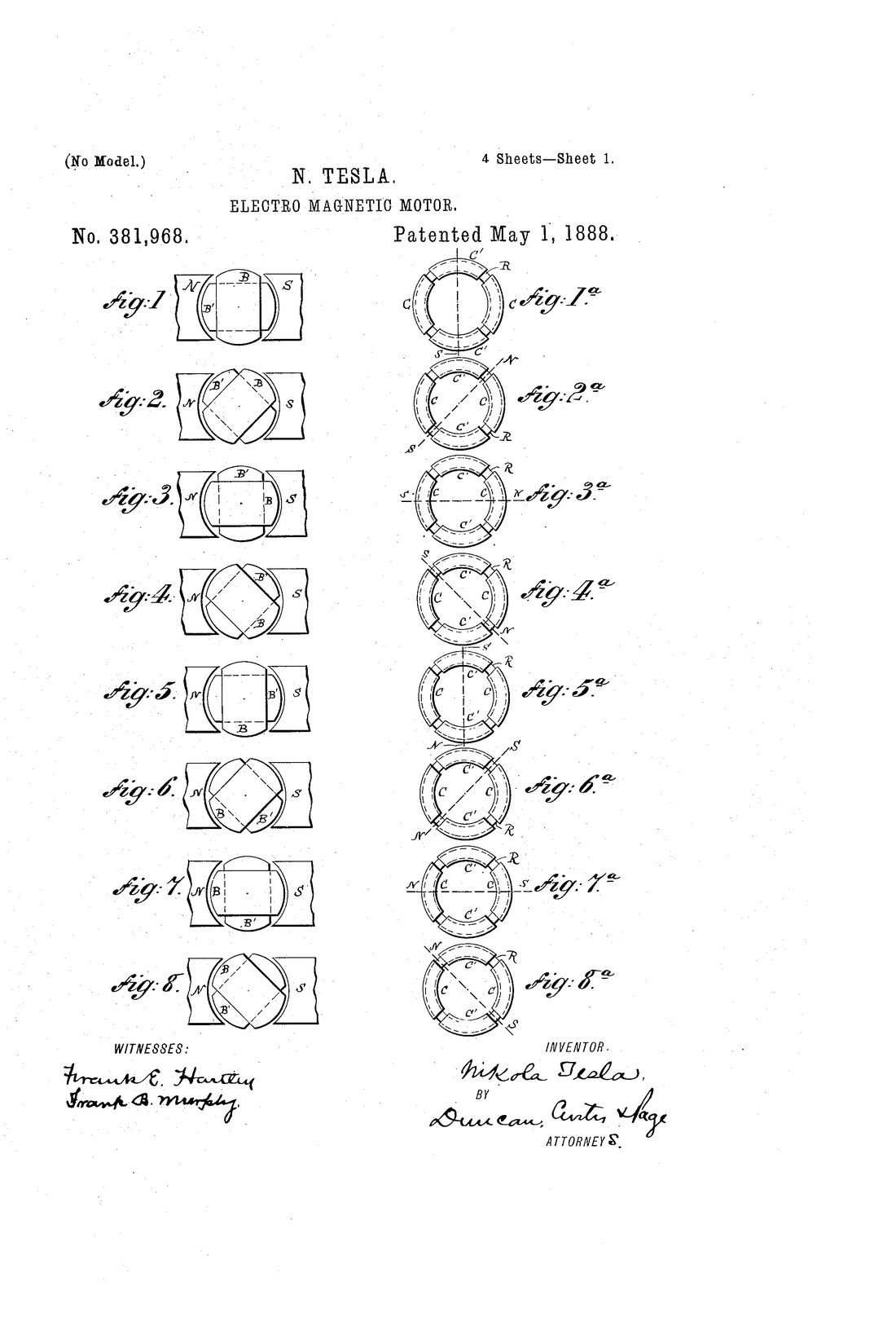
Now look back at the room.
rotating magnetic field US 381,968 · 1888
Before this page loaded, thousands of these were probably already turning within a few kilometres of you.
- pumps
- fans
- compressors
- factory equipment
- HVAC
- conveyors
- elevators
not Tesla's machines. descendants of the same engineering idea.
polyphase alternating current US 382,280 · 1888
Look for the nearest wall socket.
What comes out of it is the endpoint of an argument that was still being fought when Tesla was young. Edison sold direct current, a mile at a time. Tesla's polyphase system, bought by George Westinghouse, stepped voltage up, sent it a hundred miles, and stepped it down again. Niagara, 1896. Buffalo lit up. Nobody went back.
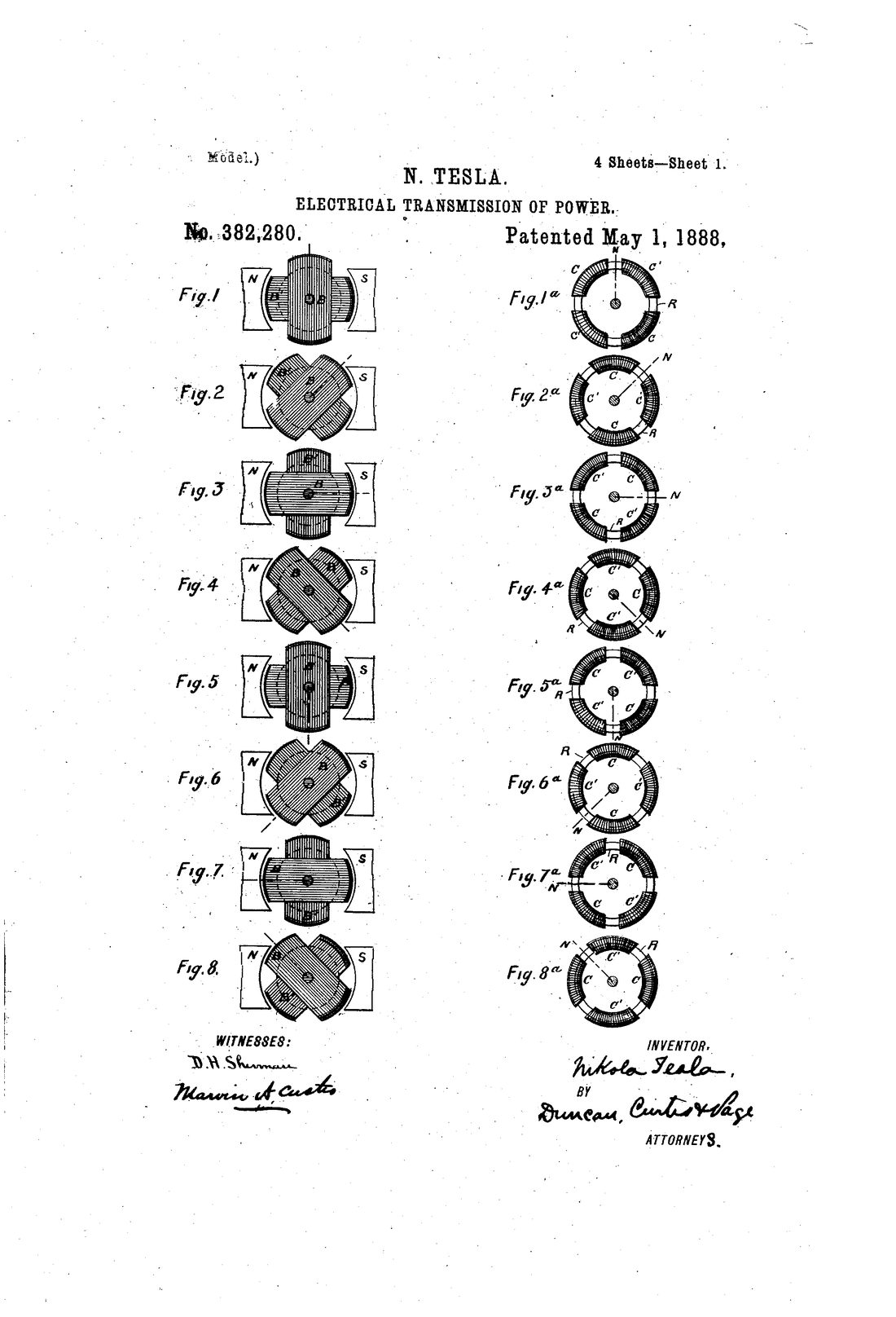
the socket six feet away is where this sheet ends.
remote control US 613,809 · 1898lineage
A room watched a machine move because a person standing elsewhere told it to.
Madison Square Garden, 1898. A small boat in a tank turned, stopped and lit its lamps on command from across the hall. The crowd looked for the trained monkey inside. That sentence no longer sounds remarkable.
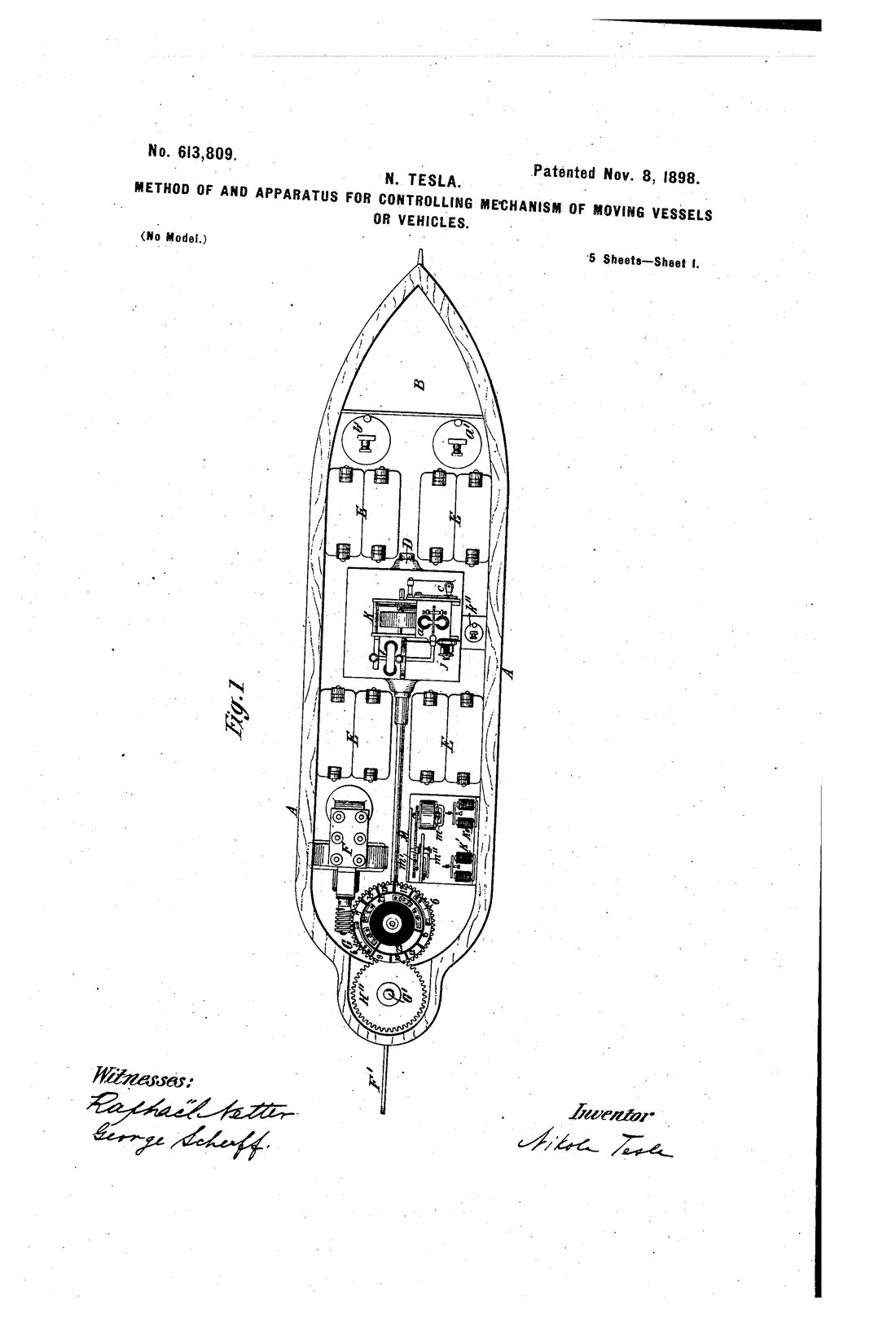
- radio control
- remotely operated vehicles
- telerobotics
- drones
lineage, not authorship. he opened a door; other people walked through it for a century.
stop counting
Stop counting.
A building. A block. A city. Every mark is an electric motor of the kind that starts on that 1888 sheet. The marks are not to scale. There are far more.
One man's notebooks are still moving an unreasonable amount of metal.
the man
That was a small part of the work.
He kept having ideas.
united states patents granted to nikola tesla, 1886 to 1928
Some of these changed the world.Some went nowhere.Some were too early.Some were simply strange.He did not seem particularly capable of stopping.
About 112 in the United States; roughly three hundred worldwide, counting the same inventions filed abroad. Some files are still open. And history contains other people: Faraday, Ferraris, Westinghouse, Edison, Hertz, Marconi, and engineers whose names are not on this page. This is not a claim that one man built modernity. It is a demonstration of how far one mind can propagate through it.
There was still only one person producing all of this.
Tesla never married.He had no children.He described celibacy as important to his work.His later life became increasingly solitary.
His ideas occupied an enormous amount of the future.
They appear to have occupied an enormous amount of him, too.
He gave the future almost everything.
He did not appear to save very much for himself.
his own account, not a law. nobody should copy the arrangement.
hotel new yorker · room 3327 · 7 january 1943
Nikola Tesla died in 1943.
This didn't.
The building. The city. Your screen.
The person ended.
The idea kept propagating.
You are reading this by borrowed light.
Somewhere in Tesla's notebooks was a future that did not exist yet.
Yours probably contains one too.
Worth Building